An intake agent with a human approval step
A no-code agent that reads a form, applies business rules, writes the record and drafts the email, then waits for a person before anything is sent.
Problem
A great deal of office work is a chain of small decisions joined by copying: read the form, check it against a rule, write it down, tell someone. Each step is simple and the chain is long, so it stays manual and slow.
Objective
Build an agent that holds the whole chain for an intake process, and stops at a person wherever a decision carries real consequence.
Technology stack
n8n for orchestration, Google Gemini as the model, Google Sheets and Gmail as tools, and a form trigger for the input.
Architecture
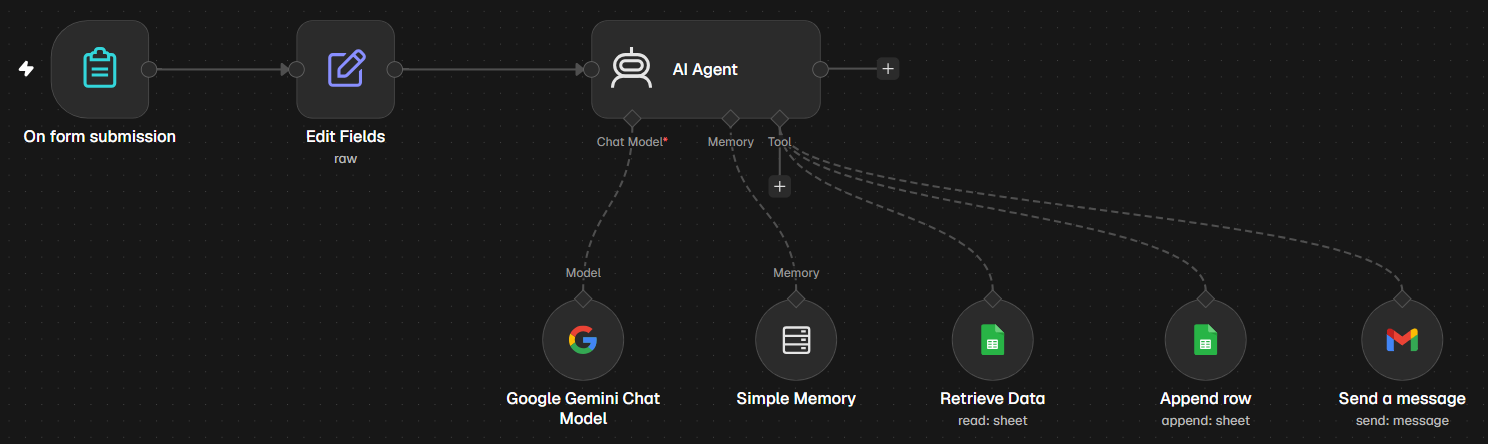
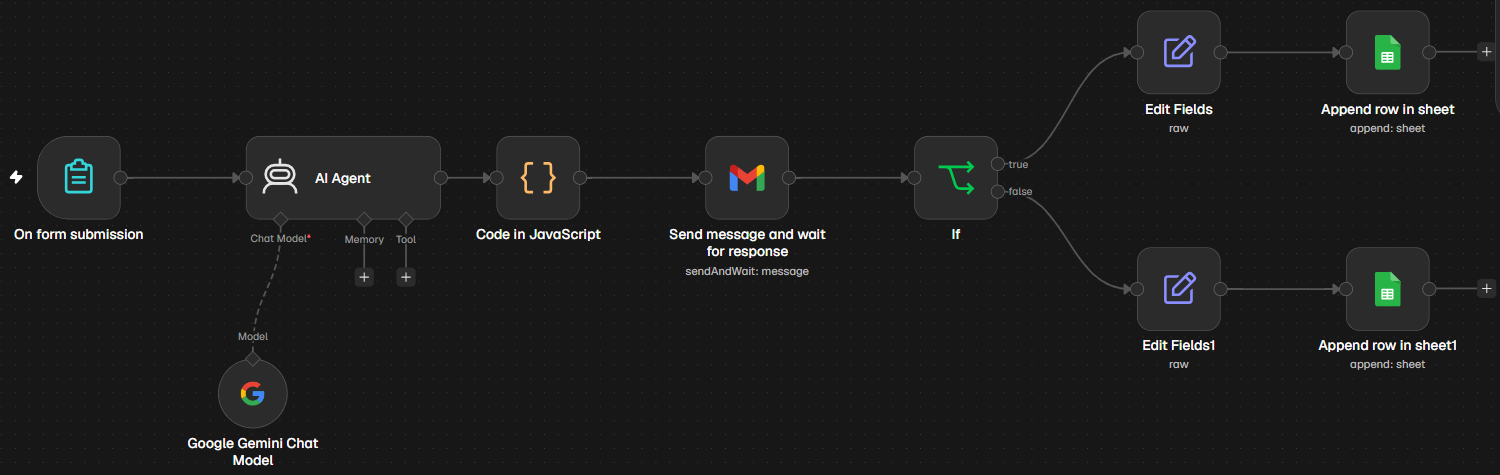
A form trigger brings the work in. A clean-up step normalises the fields. An agent node holds the model, a system prompt with five business rules written in plain language, memory, and three tools. An approval branch sits between the agent's draft and the send step. Each run is logged to a sheet.
Implementation
The rules live in the system prompt as numbered statements, so a non-programmer can read and change them. Tools are narrow: one writes a row, one sends mail, one looks a value up. The agent drafts the email and the record; the workflow, not the model, decides whether the draft goes to a person first.
The full walkthrough is in Building an AI Agent: A Step-by-Step Walkthrough.
Limitations
The agent applies written rules. A case the rules do not cover goes to a person, and the agent cannot tell a well-formed but false submission from a true one. The approval step adds a wait.
Lessons learned
Put the checkpoint in the workflow, where the model cannot skip it. Keep each tool narrow. Write the rules so the process owner can read them, because that person will be the one changing them.
Not yet written up: costs, results. I add a section when I have measured it, and leave it out until then.